
Quick answer: Yes, you can switch hands in pickleball. Rule 12.B of the 2026 USA Pickleball rulebook says you may hold the paddle with one or both hands and switch it from hand to hand at any time, even mid-rally. The one condition is that the paddle has to be in your hand when it hits the ball.
The 30-second version
- It’s legal at any time. Rule 12.B: “The paddle may be switched from hand to hand at any time.”
- You must be holding it at contact. Rule 12.B.1 makes it a fault to hit the ball with a paddle you aren’t holding, so throwing your paddle at a ball doesn’t count.
- One paddle only. Rule 12.A bans using or carrying a second paddle during a rally, so no paddle in each hand.
- Either hand on the paddle counts as the paddle. Rule 10.C.3 excuses a ball off your “hands below the wrist joint while in contact with the paddle.”
- For most players it’s a niche skill. A solid two-handed backhand solves the same problem faster. Off-hand practice still pays off for touch and as an injury backup.
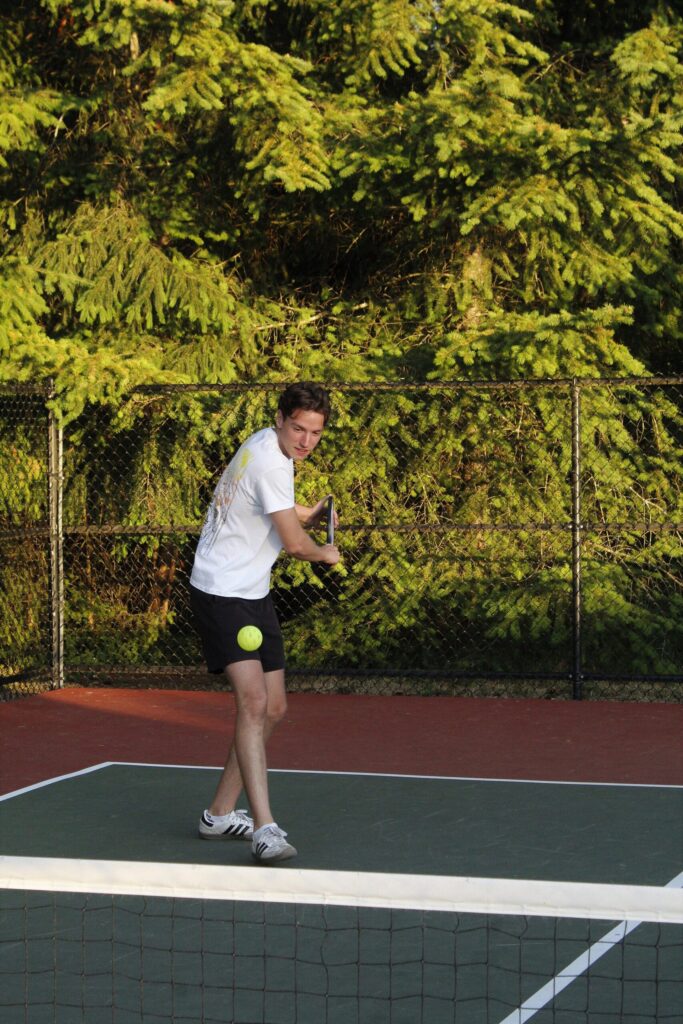
Watch a rec game long enough and you’ll see it: a ball goes wide to someone’s backhand side, and they flip the paddle to their other hand to reach it with a forehand. The other team stops and asks whether that’s even allowed. It is, and the rule is shorter than most people expect.
Can you switch hands in pickleball?
Yes, you can switch hands in pickleball whenever you want, including in the middle of a rally. Rule 12.B of the 2026 USA Pickleball Official Rulebook covers it in three sentences:
- Possession: “A player must have possession of the paddle when hitting the ball.”
- One or two hands: “A player is allowed to hold the paddle with one or both hands.”
- Switching: “The paddle may be switched from hand to hand at any time.”
There’s no limit on how often you switch, no need to tell your opponents, and no difference between singles and doubles. A player who serves right-handed and then hits a left-handed forehand three shots later hasn’t broken any rule.
What does the rule actually require?
The rule requires two things: the paddle must be in your hand when it hits the ball, and you can only use one paddle. Everything else about switching is up to you.
- Possession at contact (Rule 12.B.1). If you don’t have possession of the paddle when it hits the ball, it’s a fault against you. Throwing the paddle at a ball you can’t reach is a fault, even if the ball goes over the net and lands in.
- One paddle (Rules 12.A and 12.A.1). You can’t use or carry more than one paddle while the ball is in play. Holding a paddle in each hand so you never have to switch is a fault.
- No catching or carrying (Rule 12.C). The switch has to happen before you hit, not during. You can’t scoop the ball on the paddle face, move the paddle to the other hand and then fling it.
That last point catches people who try to be clever. The rulebook defines a carry as hitting the ball so it “does not bounce away from the paddle but is carried along on the face of the paddle.” Switch first, then make a clean hit.
What if the ball hits your other hand?
If the ball hits a hand that is touching the paddle, below the wrist, play goes on as if it hit the paddle. If it hits your free hand, it’s a fault against you.
Rule 10.C.3 makes it a fault when the ball touches a player or anything they wear or carry, “except the player’s paddle or the player’s hands below the wrist joint while in contact with the paddle.” The rule says “hands,” plural. That matters for switching and for two-handed shots:
- Two hands on the paddle: a ball that clips either hand below the wrist is treated like a paddle hit.
- Mid-switch, both hands on the handle: same thing. Both hands are in contact with the paddle.
- Free hand off the paddle: a ball off that hand, or off your forearm, is a fault.
We cover the rest of that rule in our post on body shots in pickleball.
What if you drop the paddle while switching?
If you drop the paddle while switching hands, the rally keeps going, but you probably lose the point. Under Rule 10.J, when anything you carry lands on your own side of the court, the ball stays in play.
You can pick the paddle up and keep playing if you have time, which you rarely will. Where you can get into trouble is the net. Rules 13.G, 13.H and 13.I make it a fault when anything “worn or carried” by a player touches the net, touches the opponent’s court or crosses the net plane while the ball is live. A fumbled switch close to the net can cost you the rally that way.
Can you switch hands on the serve?
Yes, you can serve with either hand, and you can switch hands between the serve and your next shot. The serve rules only limit how you release the ball and how you swing, not which hand holds the paddle.
- Release (Rule 7.B.1): the server must release the ball “using only one hand or only the paddle.” You can’t drop it from both hands at once.
- Forehand or backhand (Rule 7.C.4): a volley serve “can be made with a forehand or backhand motion.”
- Everything else stays the same: the upward arc, the paddle head below the wrist and contact below the waist (Rules 7.C.1 to 7.C.3) apply whichever hand you use.
Our serve rules guide walks through each of those checks.

When does switching hands actually help?
Switching hands helps in a small number of situations, and for most players a better backhand is the bigger win. Here’s where it can earn its place:
- Wide balls on your backhand side. A player who is close to ambidextrous can reach farther with a forehand on either side. That’s the classic case.
- Playing through an injury. If your dominant elbow or shoulder is sore, playing rec games with your other hand keeps you on court. Our pickleball elbow guide covers that injury; check with a doctor before playing through pain.
- Training touch. Dinking with your off hand makes you slow down, watch the ball and use your legs. It also shows you how much of your touch comes from your legs rather than your wrist.
Where it usually hurts:
- Fast exchanges at the kitchen. Hand battles happen too fast to change grip. Our guide to winning hands battles is built around one ready grip for a reason.
- Balls at your body. A ball jammed into your hip needs a backhand block, not a switch.
- Grip reset. Every switch means finding your grip again. If you aren’t sure where the paddle face is pointing, you’ll pop the ball up.
Switching hands vs a two-handed backhand
For a wide ball on your backhand side, a two-handed backhand is the more reliable fix for most players, because both hands stay on the paddle the whole time. Here’s how the options compare:
| Option | Best for | The cost |
|---|---|---|
| Switch hands | Very wide balls, near-ambidextrous players | Time and a grip reset on every switch |
| Two-handed backhand | Drives, counters and returns on the backhand side | Less reach; needs a longer handle |
| One-handed backhand | Reach, dinks and blocks | Harder to generate power |
Our two-handed backhand guide covers the stroke, and our two-hand backhand drive post goes deeper on hitting it hard. If you go two-handed, check that your handle is long enough for both hands; our grip size guide and how to hold a pickleball paddle help there.
How do you practice switching hands in pickleball?
You practice switching hands in pickleball by building the off hand first and then adding the switch, in short blocks. Start slow and keep each drill to about five minutes so your form doesn’t fall apart.
- Off-hand dinks. Cross-court dinks with your off hand only. Aim for 10 in a row before you add pace.
- Off-hand wall rally. Soft forehands against a wall from about 7 feet away. This builds contact without needing a partner.
- Feed and switch. A partner feeds slow balls alternately to your far forehand and far backhand. Switch hands for every ball on the backhand side, then go back.
- Shadow switches. Without a ball, shuffle to the backhand sideline, switch hands, swing and recover to the middle. Ten reps a side.
- Game test. Play one rec game where you’re allowed to switch only on balls you can’t reach with a backhand. Count how many points it wins and loses you.
That last drill is the honest one. If switching loses you more points than it wins, put the time into your backhand instead.
Where to practice in New England this winter
The off-season is the best time to work on a weak hand. Most of the drills above need only a wall or a single court, and New England’s indoor clubs and rec gyms keep running through the cold months. Our indoor pickleball in Massachusetts guide and the New England court directory list places to play, and a local coach can watch your switch and tell you whether it’s worth keeping. For the rest of the rules, start with our complete pickleball rules guide.
Frequently asked questions
Is it legal to switch hands in pickleball?
Yes. Rule 12.B of the 2026 USA Pickleball rulebook says the paddle may be switched from hand to hand at any time, including during a rally.
Can you hold the paddle with two hands in pickleball?
Yes. Rule 12.B allows a player to hold the paddle with one or both hands, which is why two-handed backhands are legal.
Is it a fault if the ball hits my hand?
Not if that hand is touching the paddle and the ball hits below the wrist. Rule 10.C.3 treats that like a paddle hit. A ball off your free hand is a fault.
Can you throw your paddle at the ball in pickleball?
No. Rule 12.B.1 makes it a fault to hit the ball when you don’t have possession of the paddle, so a thrown paddle never makes a legal hit.
Can you serve with your other hand in pickleball?
Yes. Nothing in the serve rules limits which hand holds the paddle. You must release the ball with one hand or the paddle, and the usual volley serve rules apply.
Sources: the 2026 USA Pickleball Official Rulebook (definition of Carry; Rules 7.B.1, 7.C.1 to 7.C.4, 10.C.3, 10.J, 12.A, 12.A.1, 12.B, 12.B.1, 12.C, 13.G, 13.H and 13.I). The tactical advice and drills are my own. By Jason Regan, USA Pickleball Ambassador, Leominster, MA.
