
Quick answer: A drop volley in pickleball is a soft volley that takes the pace off an incoming ball and drops it short, usually into your opponents’ kitchen. You hit it out of the air with a loose grip and a still, slightly open paddle face, so the ball dies near the net instead of bouncing up to be attacked.
The 30-second version
- It’s a volley that absorbs. Instead of punching the ball back, you cushion it so it lands short and low.
- Grip pressure does most of the work. Go loose, around a 3 out of 10, and let the paddle “catch” the ball.
- Use it against pace. It works best when an opponent drives at you from the baseline or the transition zone.
- Know the rules. You can’t volley with a foot in the kitchen (Rule 11.A), and the ball has to cross the net before you touch it (Rule 13.F).
- Drill it on a wall. Ten minutes of soft wall volleys will teach your hands faster than ten games.
What is a drop volley in pickleball?
A drop volley is a volley that takes pace off the ball and puts it down short, usually in or near the opponents’ non-volley zone. The USA Pickleball rulebook defines a volley simply as “a strike of the ball before the ball bounces.” The drop volley is a soft version of that strike: you absorb the ball’s energy rather than redirect it.
It sits between two shots you may already know. Our volley guide covers the three standard volleys: the block, the punch and the roll. The drop volley is the softest of the family. It is also different from the half volley, which you hit just after the bounce. A drop volley never touches the ground on your side.
- Block volley: a still paddle that sends a hard ball back at roughly the speed it came in.
- Punch volley: a short, firm push meant to finish a point or force an error.
- Drop volley: a soft “catch” that kills the ball short so it can’t be attacked.
When should you use a drop volley?
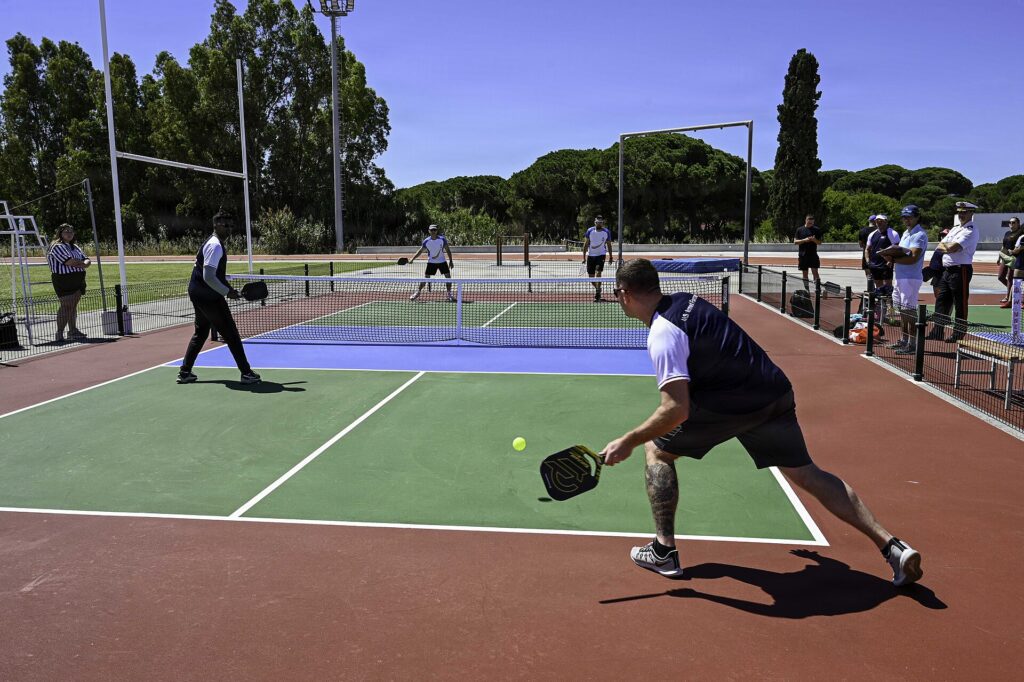
Use the drop volley when your opponent is back and you are forward. The classic picture: you’ve moved up to the kitchen line, your opponent is still at the baseline or in the transition zone, and they drive the ball hard at you. A block sends the ball deep, where they can drive again. A drop volley puts it at their feet, and now they have to hit up from a low ball while running forward.
- Against a third-shot drive. If you’re on the receiving team and the serving team drives their third shot, a drop volley can stop their advance cold.
- Against a player stuck back. If one opponent hangs back, drop volley to them and make them come forward on your terms.
- When the ball is above net height but you’re off balance. If you can’t set up for a clean punch, a soft drop is often safer than a rushed attack.
- Not when they’re both at the net. If both opponents are at the kitchen line, a short ball just sits up for them. Dink or reset instead (see our dinking guide).
How do you hit a drop volley in pickleball?
The short version is “loose hands, still paddle, open face.” Here’s how I teach it step by step.
1. Start from a ready position
Paddle up in front of your chest, knees bent, weight on the balls of your feet. If your paddle is down by your knees, every hard ball is a scramble. Our ready position guide goes deeper on this.
2. Loosen your grip
Grip pressure is the whole shot. On a scale of 1 to 10, a punch volley might be a 6 or 7. A drop volley is closer to a 3. A loose grip lets the paddle give a little at contact, which soaks up the ball’s speed. If you squeeze the handle, the paddle becomes a wall and the ball rebounds hard. A handle that fits your hand helps here; see pickleball grip size.
3. Keep the paddle face slightly open
Tilt the face a little toward the sky. A closed face drives the ball into the net. A wide-open face pops it up. You want just enough loft to clear the net and fall short.
4. Meet the ball in front of you
Make contact out in front of your body, not beside it. Contact in front gives you control over the angle. Contact late, next to your hip, tends to send the ball wide or up.
5. Don’t swing
There’s no backswing on a drop volley. Hold the paddle in place and let the ball come to it. Some players think of a tiny “give,” pulling the paddle back an inch at contact, like catching an egg. Try both and keep the one that gives you the softer landing.

Where should you aim a drop volley?
Aim short and low, at the feet of the player who is farther back. The goal is a ball that bounces in or near the kitchen and stays below the top of the net, so your opponent can’t attack it.
- Short crosscourt gives you the most room. The net is 34 inches at the center and 36 at the sidelines (Rules 3.B.6 and 3.B.7), and the diagonal is the longest distance on the court.
- To the player hitting from deep. They have the farthest to run, and they’re hitting up.
- Away from a player already at the kitchen. A drop volley in front of a net player just gives them an easy dink or speed-up.
What are the rules for volleying near the kitchen?
The drop volley is a volley, so every volley rule applies. These are the ones in the 2026 USA Pickleball rulebook that matter most for this shot.
| Situation | What the rule says | Rule |
|---|---|---|
| Volleying from the kitchen | All volleys must start outside the non-volley zone. Touching the zone while volleying is a fault. | 11.A, 11.A.1 |
| Momentum after the volley | If your momentum carries you into the zone, even after the ball is dead, it’s a fault. | 11.A.2 |
| Stepping out to volley | After touching the zone, both feet must be back outside before you volley. | 11.A.3 |
| Reaching over the net | The ball must fully cross to your side before you hit it. | 13.F |
| Volleying the serve or return | The serve and the return must each bounce before being hit. | 10.A |
Two practical takeaways. First, because of the two-bounce rule, the receiving team’s earliest volley is the serving team’s third shot, and the serving team can’t volley until the shot after that. Second, the momentum rule bites most on soft volleys: you lean in to catch the ball, and your next step lands on the line. The kitchen rules guide and can you volley in the kitchen? cover the edge cases.
What are the most common drop volley mistakes?
Almost every missed drop volley comes from too much paddle: too tight, too much swing or too much loft. Here are the five I see most.
- Squeezing the handle. The most common one by far. A tight grip turns the drop into a block, and the ball goes deep.
- Swinging at it. Any backswing adds pace. Hold the paddle still.
- Too much loft. An open face is good. A face pointed at the sky pops the ball up for an overhead.
- Dropping to the wrong player. If your target is already at the net, the drop becomes their put-away.
- Leaning into the kitchen. You reach for a soft ball, your weight goes forward, and your foot follows. That’s a fault under Rule 11.A.2.
What drills help you learn the drop volley?
The drop volley is a “hands” shot, and hands improve with repetition. These three drills take about 10 minutes in total.
- Soft wall volleys (3 minutes). Stand about 7 feet from a wall. Volley continuously, as softly as you can while keeping the ball going. Count your streak. Our wall drills page has more variations.
- Drive-and-drop with a partner (4 minutes). Your partner stands at the baseline and drives balls at you at the kitchen line. Your only job is to drop each one into the kitchen. Switch after 20 balls.
- Grip-pressure ladder (3 minutes). Volley 10 balls at a grip of 8, 10 at 5, and 10 at 3. Watch where each set lands. Most players are surprised how much shorter the ball goes at a 3.
If a drop volley pops up, the next shot is often a reset. Our guide on how to reset in pickleball covers getting the point back to neutral.
Where can you practice the drop volley in New England this winter?
November is when most New England play moves indoors, and gym open play is a good place to work on soft hands, since the points are often slower and there’s more time at the net. Our indoor pickleball in New England guide lists indoor options by state, and the court directory shows outdoor courts for the mild days. If you’re thinking about your paddle as well, the Paddle Finder matches paddles to how you play.
Frequently asked questions
What is a drop volley in pickleball?
A drop volley is a soft volley that absorbs an incoming ball’s pace and lands it short, usually in the opponents’ kitchen. You hit it out of the air with a loose grip and a still, slightly open paddle face.
What is the difference between a drop volley and a block volley?
A block volley uses a firm, still paddle and sends a hard ball back with most of its pace. A drop volley uses a loose grip to absorb that pace, so the ball falls short near the net instead of going deep.
Can you hit a drop volley from inside the kitchen?
No. Under Rule 11.A of the 2026 USA Pickleball rulebook, all volleys must be started outside the non-volley zone, and touching the zone while volleying is a fault. You can step into the kitchen to play a ball that has already bounced.
When should you use a drop volley in pickleball?
Use it when you’re at the net and your opponent is back at the baseline or in the transition zone, especially against a hard drive. Avoid it when both opponents are already at the kitchen line, because a short ball sits up for them.
How tight should you hold the paddle for a drop volley?
Loose. I coach grip pressure on a 1-to-10 scale, and a drop volley sits around a 3. A loose grip lets the paddle cushion the ball. A tight grip makes the ball rebound with more pace.
Sources: 2026 USA Pickleball Official Rulebook, definitions and Rules 3.B.6, 3.B.7, 10.A, 11.A to 11.A.3 and 13.F (read November 5, 2026). Technique advice is Jason’s own coaching experience. By Jason Regan, USA Pickleball Ambassador, Leominster, MA.
