
Quick answer: Yes, you can reach over the net in pickleball, but only in two situations. Your paddle may cross on the follow-through after you hit a ball that was already on your side. And you may reach or even walk around the net to hit a ball that bounced on your side and then went back over by itself. In every other case, crossing the plane of the net while the ball is live is a fault.
The 30-second version
- Contact first, cross second. Rule 13.I.1 lets you cross the plane of the net only after you hit the ball.
- Let the ball come to you. Rule 13.F says the ball must entirely cross to your side before you touch it.
- Backspin is the big exception. If the ball bounces on your side and goes back over, you can go get it.
- Never touch the net or their court while the ball is live. That is a fault every time.
- In rec play it is your own call. Opponents can mention a net fault. They can’t enforce it.
It comes up at open play all over New England. Somebody crushes a floater that was hanging over the tape, and the other team says you can’t reach over the net. Sometimes they are right. The answer sits in Section 13 of the 2026 USA Pickleball rulebook, and it is more generous than most players think. This guide gives each case with its rule number so you can settle it at the fence.
What is the plane of the net?
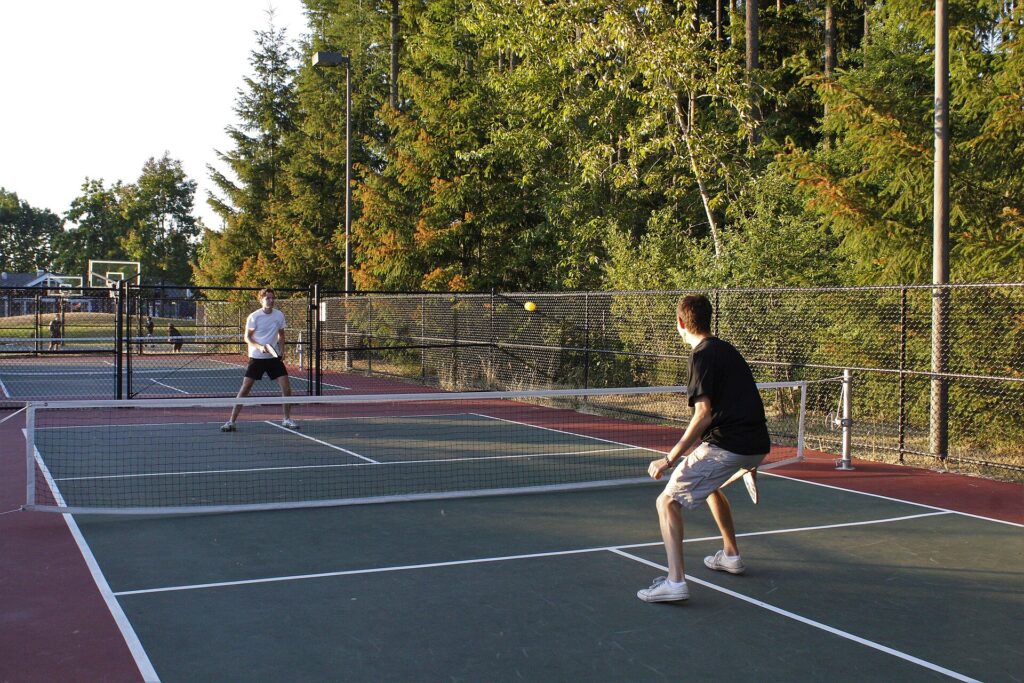
The plane of the net is an imaginary wall that runs along the net and keeps going in every direction. The rulebook defines it as “the vertical plane in line with the net extending above, below, and to both sides of the net.”
The plane does not stop at the posts or at the top of the tape. Three different moves all count as crossing it:
- Over. Your paddle or arm reaches above the net.
- Around. Your body or paddle passes outside a net post, as on an Erne.
- Under. A foot or a dropped paddle slides beneath the net.
Rule 13.I covers all three. It says a player, or anything the player wears or carries, must not cross the plane while the ball is live, with two exceptions.
When can you reach over the net in pickleball?
You can reach over the net in pickleball right after you hit the ball, and when a ball that bounced on your side travels back over the net untouched. Those are the only two exceptions in Rule 13.I.
| Situation | Legal? | Rule |
|---|---|---|
| Paddle crosses on the follow-through, after contact on your side | Yes | 13.I.1 |
| You hit the ball before it has fully crossed to your side | Fault | 13.F.1 |
| Paddle crosses before you make contact | Fault | 13.I.1.a |
| You reach over, swing and miss | Fault | 13.I.1.b |
| Ball bounces on your side, goes back over, then you reach across and hit it | Yes | 13.I.2 |
| You touch the net while the ball is live | Fault | 13.G.1 |
| You touch the opponent or their side of the court while the ball is live | Fault | 13.H.1 |
Can your paddle cross the net on a follow-through?
Yes. Your paddle can cross the net on a follow-through as long as you hit the ball first and the ball was on your side when you hit it. Rule 13.I.1 says a player “may cross the plane of the net immediately after hitting the ball.”
Two limits come with that permission.
- The ball has to arrive. Rule 13.F requires the ball to “entirely cross” to your end of the net before you hit it. A floater sitting on top of the tape is not yours yet.
- The allowance is short. It applies only “while executing the current strike of the ball and for continuation associated with the current strike.” When the swing ends, bring the paddle back.
The swing and miss surprises people. On your own side a whiff costs nothing, because Rule 10.E says the ball stays live. Reach across the plane and miss, and Rule 13.I.1.b makes it a fault. Our guide to the putaway covers the contact point.
What happens when backspin pulls the ball back over the net?
When a ball bounces on your side and then travels back over the net without being touched, you are allowed to cross the plane to hit it. Rule 13.I.2 says you may go “over, under, or around the net” to do it. This is the one time you can legally make contact on the opponent’s side.
The rule does not say what has to cause it. Heavy backspin on a short drop is the usual reason. A gust on an outdoor court can do the same thing, as our wind guide explains.
There are three conditions, and each one has its own fault:
- Wait for the ball. You may cross only after the ball has crossed back. Go early and it is a fault under 13.I.2.a.
- Get there in time. You must hit it before it bounces on the opponent’s side. If you don’t, Rule 13.I.2.b gives the rally to them.
- Stay off everything. You still can’t touch the net, the opponent or their side of the court.
Going around the post is usually easier than leaning over the net without touching it. Rule 10.C still applies, so your shot has to land on the opponent’s end of the court. To hit the shot that causes all this, start with how to add spin.
Is it a fault to touch the net in pickleball?
Yes, touching the net is a fault whenever the ball is live. Rule 13.G covers you and “anything that is worn or carried” by you, and it covers both the net and the hardware holding it up, which the rulebook calls the net support system.
Timing decides most arguments here. Rule 9.B.1 says a fault can only happen while the ball is live. Kitchen momentum is the single exception. The ball goes dead on its second bounce, so the order of events matters:
- You stumble into the net before your winner bounces twice. Fault on you. You lose a rally you had won.
- You touch the net after the second bounce. No fault. The rally was already over.
- Your hat or paddle lands on their side during the rally. Fault under 13.H. If it lands on your own side, Rule 10.J says play on.
One detail few players know: the rulebook defines a live ball as running “from the start of the score call until the ball becomes dead.” So the net rules switch on when the server starts calling the score.
Keep these apart from the kitchen rules, which are about your feet when you volley. The net rules apply to every shot. Our list of pickleball faults shows how they fit together.
Can you hit the ball around the net post?
Yes. Rule 13.C says “a ball may be returned around the outside of the net post,” which is what makes the around-the-post shot legal. Two neighbors of that rule are worth knowing:
- Not between the net and the post. Rule 13.D makes that a fault. It matters on nets that leave a gap at the end.
- Not under the net. Rule 13.E makes that a fault as well.
The Erne falls under the same section. Your follow-through may cross the plane outside the post once you have hit the ball. Landing on the opponent’s side before the ball is dead is a fault under 13.H.
What changes on a portable net?
On a portable net, the frame becomes part of the game, and Section 13 has three replay rules that cover it. That matters in a New England winter, because a lot of our indoor play happens in school gyms and rec centers on roll-out nets. Our indoor guide lists where.
- Ball hits the crossbar or base after crossing. If a return crosses the net and then hits a crossbar or another part of the frame inside the court, replay the rally (13.B.2).
- Ball catches in a sagging net. If a return crosses and then gets caught in the net, or hits net that is draped on the floor, replay it (13.A.1).
- The net falls over or comes apart. A net malfunction during a rally means a replay (13.J).
- Your shot hits the frame first. If your return hits the support system before going over, it is a fault on you (13.B.1). A serve that hits any part of the frame is a fault too.
Check the height before you start. Rule 3.B sets the net at 36 inches at the sidelines and 34 inches at the center, give or take a quarter inch. Portable nets tend to sag in the middle, and a low net changes every dink. Our net guide covers what to buy, and indoor vs outdoor pickleball covers what else changes inside.
Who calls a net fault in rec play?
You call it on yourself. Rule 9.B.2 says players are expected to call faults on themselves or their partner as soon as the fault happens.
Under Rule 9.B.3, the only faults you may call on the other team are kitchen faults and service foot faults. For anything else, including touching the net or reaching over early, Rule 9.B.4 says an opponent “may mention the specific fault” after the rally but has “no authority to enforce” it. The final decision belongs to the player who allegedly did it.
So if you felt the net, say so and give up the point. It is the same honor system behind line calls and the rest of pickleball etiquette.
How do you practice staying legal at the net?
You practice it by drilling the two moments where players break the rule: hitting too early and failing to stop. These two drills need one partner.
- Let it cross. Your partner feeds soft floaters that peak above the tape. Hit only the ones that have fully crossed. Do twenty.
- Hit and freeze. Put away a high feed from the kitchen line, then hold your balance until the ball bounces twice. Ten clean ones in a row.
For more, see our pickleball drills, or find a teacher in the New England coach directory.
Frequently asked questions
Can you reach over the net in pickleball?
Yes, in two cases. Your paddle may cross after you hit a ball that was on your side, and you may cross to hit a ball that bounced on your side and went back over untouched. Otherwise it is a fault.
Can you hit the ball before it crosses the net?
No. Rule 13.F says the ball must entirely cross to your side of the net before you hit it. Hitting it early is a fault.
Is it a fault if your paddle touches the net?
Yes, if the ball is still live. Rule 13.G covers you and anything you wear or carry. After the ball is dead, touching the net is not a fault.
What if the ball bounces back over the net by itself?
You may reach over, under or around the net to hit it, but only after the ball has crossed back. If you don’t hit it before it bounces on the other side, you lose the rally.
Can my opponent call me for touching the net?
Not in a match without a referee. Under Rule 9.B.4 an opponent can mention it after the rally, but the decision belongs to the player who allegedly committed the fault.
Sources: the 2026 USA Pickleball Official Rulebook: Section 2 definitions, Rules 3.B.6 and 3.B.7, 9.B.1 through 9.B.4, 10.C, 10.E, 10.J and Section 13. Rule text was read on October 13, 2026. The drills are our own. By Jason Regan, USA Pickleball Ambassador, Leominster, MA.