Quick answer: Here is how to win the kitchen bounce shot in pickleball. Decide to let the ball bounce the instant you see it landing short, get your feet moving immediately, open your hips toward your target, and step in so contact happens at the apex of the bounce — the highest point the ball reaches on its way back up. Contact at the apex lets you hit forward and slightly down through the ball. Contact on the way down forces you to lift it, and that is the shot that floats up and gets crushed.
The 30-second version
- Letting it bounce is not the mistake. The mistake is what you do in the second and a half after you decide.
- Decide early or you have already lost it. If you are still choosing between volley and bounce as the ball lands, you cannot get set in time.
- The apex is the whole game. Meet the ball at the top of the bounce and you get to hit down and forward. Meet it late and you are lifting.
- Open your hips, do not stay square. A square stance leaves the paddle nowhere to go except across your body.
- Momentum forward, always. Weight drifting backward at contact is the single biggest cause of nets and floaters off the bounce.
- Keep the swing short. You are a few feet from the net. A big takeback is just a bigger margin for error.
Watch any 3.0 or 3.5 open play for ten minutes and you will see this exact point die over and over. Somebody hits a genuinely good third-shot drop. It lands soft in the kitchen. The player across the net does the smart thing and lets it bounce — and then just stands there, square to the net, waiting for the ball to come back to them. They swing with their weight going backward, and the ball either dumps into the tape or floats up to belly height for the other team to put away. I have watched it happen at Doyle Field in Leominster and I have watched it happen indoors in January. It is not a talent problem. It is a setup problem, and it is one of the most fixable things in the sport.
Why does the kitchen bounce shot go wrong so often?
Because most players treat a good drop as a concession. Your opponent executed, the ball is at your feet, and something in your head says survive this one. So you go passive.
- You freeze instead of moving. The decision to let it bounce should trigger footwork, not stillness. Most players make the decision and then stop moving entirely.
- You stay square to the net. Hips closed, shoulders flat, paddle out front. It feels ready. It is actually a dead end for the swing.
- You let the ball come to you. The ball bounces, rises, peaks, and starts falling — and you contact it somewhere in that falling phase, low and late.
- Your weight goes backward. Because you did not step in, your only way to reach a dropping ball is to lean back off it.
That last one is the killer. Backward momentum at contact is why the ball dies in the net or sails long. You are not adding energy the ball did not need — you are subtracting the energy it did need, and hoping your wrist makes up the difference.
Here is the reframe that fixes it: a ball that lands in your kitchen is not a problem you survive. It is a short ball, and short balls are opportunities. You still hold the net position. You still have the better court. You just have to be set up to use it.
What does the apex actually do for you?
The apex is the highest point the ball reaches after it bounces. Every ball that lands in the kitchen climbs to that peak and then starts dropping again. Where you choose to make contact in that arc decides almost everything about the shot you get to hit.
Contact after the apex, on the way down. The ball is below net height, or getting there. Your only option is to open the face and lift. Lifting means the ball travels upward across the net, which means it arrives at your opponent above net height. You have handed them the attack.
Contact at the apex. The ball is at its highest, which is often at or near net height. Now your paddle can travel forward and slightly downward through it. That is a completely different shot — it stays low over the tape, it lands at their feet, and it puts them in exactly the spot you were just in.
That is the entire difference between applying pressure and just keeping the ball in play. It is not a stronger swing. It is a better meeting point.
The catch is that you cannot time the apex if you are still deciding. The apex arrives roughly half a second after the bounce. If your feet do not start moving until the ball has already landed, you will be late every single time, and late means dropping ball, and dropping ball means lifting. The decision has to come first.
How do you set up your feet for a kitchen bounce shot?
Four steps, in order. They take much longer to read than to do.
Step 1 — Commit the moment you read it short. You can tell a ball is landing in the kitchen well before it gets there, from the arc and the pace off their paddle. The instant you read it, the decision is made. Do not hedge with the paddle up in volley position and then bail out.
Step 2 — Move your feet on the decision, not on the bounce. Your split step should land as they make contact, and then you are stepping toward where the ball will bounce, not where it is now. Get there early enough to be waiting for it.
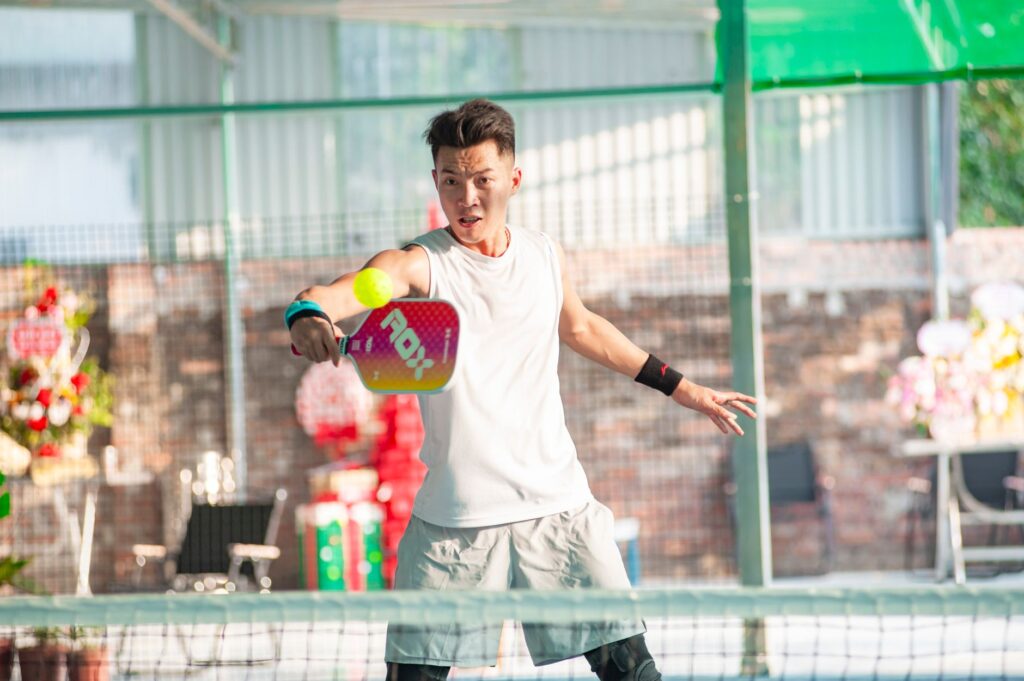
Step 3 — Open your hips toward your target. On the forehand side, your lead hip rotates open. On the backhand side, the opposite hip opens to clear a path for the paddle. Either way, you are creating room for the paddle to travel forward instead of jamming across your chest.
Step 4 — Step in and meet it at the top. Time the step so your weight arrives as the ball hits the apex. Contact happens out in front, with your momentum going toward the net, not away from it.
If you want a single cue for all four: forward momentum is pressure, backward momentum is errors. Everything above is just a way to guarantee the first one.
Why do your hips matter more than your arm?
This is the part most rec players skip, and it is mechanical rather than stylistic.
When your hips stay square to the net, your paddle has exactly one path available — across your body. That path bleeds pace and it bleeds direction, because your arm is fighting your own torso the whole way. You end up steering with the wrist, which is why the same swing produces three different results.
When you open the hips before contact, the paddle gets a clear lane to travel forward and through the ball. Now the rotation is doing the work and the arm is just holding the angle. It is more repeatable, it is less tiring, and it is the same mechanic that powers a real drive from the baseline — just scaled down.
Think of the hip rotating to face where you want the ball to go, not where the net is.
How compact should the swing be?
Very. This is where anyone with a tennis background gets into trouble, and I say that as someone who has watched a lot of converts work through it.
At the kitchen line the net is right there and you have very little room in front of you. A full groundstroke takeback in that space is not a weapon, it is a liability — more moving parts, more timing windows to miss, and a small target to hit.
- Start the paddle close. Roughly where your ready position already is. If your paddle goes behind your hip, the takeback is too big.
- Drive through, do not punch or block. This is not a volley. It is a controlled forward stroke with the body behind it.
- Finish out front. A short, forward finish keeps you balanced and ready for the next ball, which at the kitchen line is coming fast.
Compact does not mean tentative. The body rotation supplies the pace. The arm just keeps the face honest.
Where should the ball actually go?
Getting the timing right earns you a choice, so use it. Three targets, in rough order of how often I would take them:
- Their feet, crosscourt. The longest distance on the court, the lowest part of the net, and the hardest ball to do anything with. This is the default and it should be most of your kitchen bounce shots.
- The middle. Straight into the seam between two players. Nobody is quite sure whose ball it is, and even a clean answer comes back soft.
- Behind them, only if they leaned. If somebody has already committed their weight forward, a firmer ball at the hip or shoulder is free. But this is a read, not a plan.
What you are almost never trying to do is win the point outright from a ball that bounced in your kitchen. You are trying to hand the awkward ball back. If you want the deeper version of this thinking, our guide to point construction covers how these neutral shots chain into actual winners.
How do you drill this without a coach?
You need a partner and about ten minutes. No ball machine required.
Drill 1 — Feed, bounce, apex (5 minutes). Partner stands at their kitchen line and feeds soft balls into your kitchen. You let every single one bounce. No volleys allowed, even on the ones you could easily take out of the air. The only goal is contact at the top of the bounce. Have your partner call out early, apex, or late after each one. Most people are surprised how many are late.
Drill 2 — Hips first (3 minutes). Same feed, but now your partner watches only your hips. If you contact the ball with your hips still square to the net, that rep does not count. This is deliberately annoying and it works fast.
Drill 3 — Freeze the finish (2 minutes). Same feed, and you hold your finish position for a full beat after contact. If you can hold it comfortably, your weight was going forward. If you have to catch your balance backward, you did not step in. Instant, honest feedback with no coach required.
Run those three for a couple of weeks and the timing stops being conscious. If you want more of this kind of structured work, the drills library has progressions for the rest of the soft game, and wall drills cover what to do when you cannot find a partner.
Does anything change on a New England outdoor court?
Yes, and it is worth planning for, because most of our season is outdoors.
- Cold ball, lower apex. On a fifty-degree April morning in Massachusetts the ball is stiffer and deader, and it simply does not bounce as high. The apex arrives lower and sooner, so you have to get in earlier and accept that the ball may be below net height at its best moment. Bump your target up a few inches over the tape.
- Wind changes the bounce, not just the flight. A ball landing into a headwind sits up. A ball landing with the wind kicks forward at you. Our guide to playing in the wind goes deeper, but the short version is to give yourself an extra half step of room.
- Rough town-court surfaces are unpredictable. Plenty of the converted tennis courts across New England have seams, patches and grit. On a chewed-up surface, take the ball a touch earlier rather than trusting a clean bounce.
- Indoor season is the best time to learn it. Gym floors give a true, consistent bounce, which is exactly what you want when you are grooving timing. Our indoor pickleball guide lists where to play through the winter.
Frequently asked questions
Should I ever volley a ball that is dropping into the kitchen instead of letting it bounce?
Only if you can take it above net height. If you have to reach down for it, you are hitting up from an awkward position with no time — letting it bounce and meeting the apex is almost always the better ball. Note that you cannot volley while standing in the kitchen at all, so if the ball is going to land in there and you are close to the line, bouncing is your only legal option anyway. See our kitchen rules guide.
How is the kitchen bounce shot different from a reset?
A reset is what you hit when you are under pressure and out of position, usually from the transition zone, and the goal is purely to neutralize. This shot is hit from a set position at the line, and you have enough time to do something with it. Different situation, different intent. Our reset guide covers the defensive version.
What if the ball bounces so low I cannot get to the apex in time?
Then it becomes a half-volley — you catch it just after the bounce, on the rise, with a very short compact stroke. That is a legitimate answer, not a failure. The rule of thumb is that if you cannot get set, shorten everything and just get it back low and soft.
Does this apply to dinks too, or only drops?
It applies to any ball that bounces in your kitchen, including dinks. On a dink the arc is smaller so the apex window is tighter, but the same principle holds: meet it at the top with your hips open and your weight going forward, and the dink stays low instead of floating.
At what level should I be working on this?
It pays off fastest at 3.0 to 4.0. Below that, players usually are not hitting enough good drops for it to come up often. Above 4.0 it is already assumed. If you are somewhere in the middle, this is one of the cheaper rating points available — see our 3.5 to 4.0 guide.
Source note: the apex-timing and hip-rotation points in this article were prompted by a breakdown published by The Dink Pickleball on 28 August 2026, which drew on video coaching published on YouTube. The four-step setup, the target hierarchy, the three drills and the New England specifics above are our own.
Written by Jason Regan, who runs Regan Family Pickleball out of Leominster, Massachusetts, and has lost more points than he cares to admit standing flat-footed while a perfectly playable ball bounced in front of him. Want a set of eyes on your setup? See coaching.
Related reading: how to dink · the half-volley · the wide dink · transition zone footwork