Why do you keep getting beat down the line in pickleball?
Because the winner was set up a shot earlier. A ball hit down the line in pickleball only becomes available when the line is already open — usually because your own cross-court ball drifted too wide or landed too short, or because you stayed planted while the ball traveled. The fix is not faster hands or camping on the sideline. It is moving with the ball so the line closes on its own, while staying connected to your partner so the middle does not open instead. Below: what creates the gap, how to shift as a pair, when to bait the line on purpose, and three drills that make it automatic.
The 30-second version
- Getting passed down the line is a positioning problem, not a reaction problem — the opening was created by the shot before it.
- Your position is set by where the ball is, not by where you happen to be standing. Move as the ball travels, not after it lands.
- Stay roped to your partner — roughly 8 to 10 feet apart, shifting together as one unit.
- Wide and short cross-court balls are what hand over the angle. Aim deeper and closer to the middle.
- Fix it with three drills: the line-change reaction drill, shadow shifting, and two-on-one line pressure.
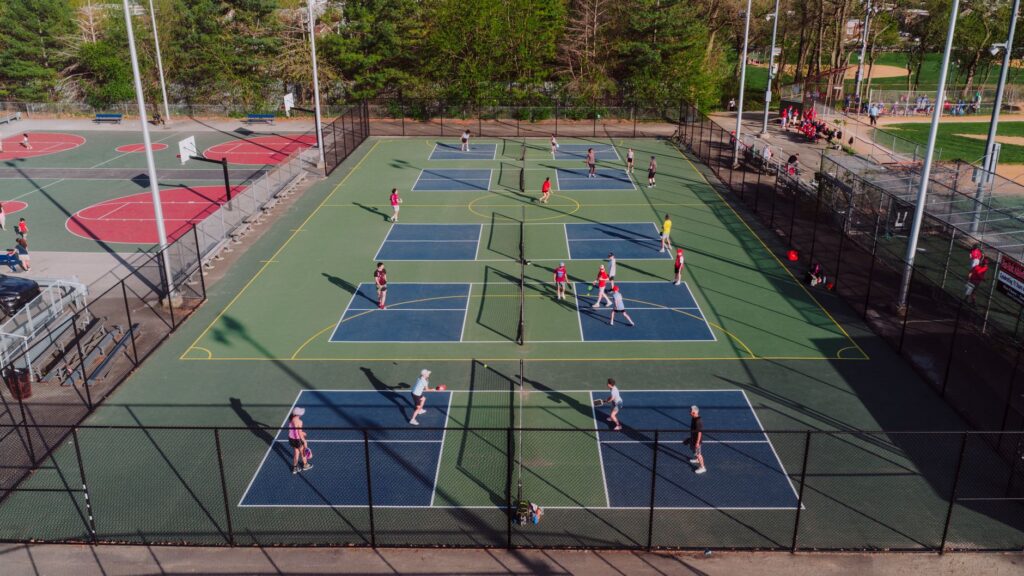
Nothing stings quite like it. You are in a comfortable cross-court dink rally at the kitchen line, everything feels under control, and then your opponent flicks one straight past your hip and it is over before your paddle moves. It looks like a brilliant shot. Nine times out of ten it was not — it was an opening you handed over. Getting beat down the line in pickleball is one of the most common complaints I hear at open play around Central Mass, and it is also one of the most fixable things in the sport. Here is what actually creates the gap, how to close it without leaving the middle wide open, and the drills that make good positioning automatic.
What does “down the line” mean in pickleball?
In doubles, most balls travel cross-court — diagonally, from your side of the court to the opponent standing diagonally across from you. A ball hit down the line goes the other way: straight ahead, parallel to the sideline, at the opponent directly across the net from you.
It matters because the two paths are not equal. The cross-court path is longer, and it crosses the net at its lowest point — the net is 34 inches in the center and 36 inches at the posts. So a down-the-line ball has less court to work with and a higher piece of net to clear. On paper it is the lower-percentage shot.
Which is exactly why it is so frustrating when it beats you. It should not have worked. If it did, the geometry was not the problem — your feet were.
Why does getting beat down the line feel so random?
Because you remember the last shot instead of the one that caused it. The winner is loud and obvious. The wide dink two seconds earlier that pulled your opponent off the court and swung the angle open is invisible.
There is a two-shot delay between the cause and the damage, and almost nobody watches for it in real time. It is the pickleball version of blaming the fumble instead of the missed block. Once you start reviewing the previous ball instead of the final one, the pattern shows up immediately — and it is almost always one of four things.
What actually creates the down-the-line opening?
Four causes account for nearly every line pass I see at the 3.0 to 4.0 level. Work through them in order.
- Your cross-court ball drifted too wide. A dink that pulls your opponent out past the sideline does not just stretch them — it hands them a brand-new angle back into your court. The wider you send them, the more court opens behind you. Wide feels aggressive. It is usually a gift.
- Your cross-court ball landed too short. A short ball lets your opponent step in and take it early and high. Early contact means you get less time to shift, and high contact means they can change direction without hitting up. Depth buys you the half second you need to move.
- You watched instead of shifted. This is the big one. Your eyes track the ball beautifully; your feet stay glued. Every foot the ball moves laterally, you should be moving with it. Standing still and hoping is not defense.
- You over-shaded to the middle. Everyone hears that the middle is where points are won, so they creep in. Creep in far enough and you are not covering the middle any more — you are just abandoning your own sideline and inviting the pass.
Notice that three of the four happen before the ball that beats you. That is why this is a strategy problem, not a hand-speed problem.
How do you cover the line without leaving the middle open?
Here is the mental model that fixes it fastest: imagine a rope about 8 to 10 feet long tying you to your partner. Neither of you can move without pulling the other. You are not two players covering two halves — you are one wall sliding left and right together.
From there, the rules are simple:
- When the ball is wide on your side, you take the sideline and your partner slides toward the middle. You are the one under pressure, so you protect the shorter, more dangerous path. Your partner covers what you vacated.
- When the ball is in the middle, both of you center up. No one guards a sideline that is not being threatened.
- Shift two to three feet, not six. Big panicky lunges are what actually open the court. Small, early adjustments keep you balanced and keep the rope tight.
- Turn your body toward the ball, not toward the net. Squaring up to the ball puts your paddle in the passing lane naturally, so you cover the line with your position instead of your reach.
Done well, this looks boring from the sideline — which is the point. Good doubles positioning is two people moving a couple of feet at a time, constantly, and never getting stretched. If you want the full picture of where to stand and when to move up, my guide to pickleball court positioning goes deeper on the whole-court version of this.

When should your partner take the line instead?
Sometimes the right answer is not for you to cover the line at all — it is for your partner to take the ball before it ever gets there. That is poaching, and against a player who telegraphs the down-the-line change it is devastating.
Two things make it work:
- Call it out loud, early. Say it before the ball is struck, not while you are both reaching for it. Silent poaching is how partners end up watching a ball land between them. My guide to partner communication covers the calls worth agreeing on before you play.
- Whoever crosses, the other rotates behind. If your partner jumps the line, you slide over to cover the court they left. This is the same instinct behind stacking — the pair keeps its shape even as individuals move.
Can you bait the down-the-line shot on purpose?
Yes, and it is one of the more satisfying plays in the sport once you can do it. The idea is to show the line, then close it late.
You shade a step toward the middle while your opponent is still preparing, so the line looks open and inviting. As they commit to the shot, you push back toward the sideline. Because the down-the-line ball has to clear the higher part of the net and land in a narrower strip, a defender who is already moving into it turns a would-be winner into a routine put-away.
Two cautions. First, only bait against players who wind up and telegraph — do it against someone with quick hands and you have simply given away the line. Second, bait the line, never the middle; a middle ball is the highest-percentage shot in pickleball and there is no reason to invite one.
Three drills that close the line for good
Drill 1 — Line-change reaction. Start a cross-court dink rally at the kitchen. Your partner may change direction and go down the line at any time, without warning, but no more than roughly one ball in five. Your only job is to shift with every ball so the change never catches you flat-footed. Play to 15 line changes and count how many you cover cleanly. Most players start around 5 of 15 and are past 12 within a couple of sessions.
Drill 2 — Shadow shifting, no ball. Two players stand at the kitchen line about 8 feet apart. A third person points slowly left and right; the pair shifts together, staying the same distance apart the whole time. Sixty seconds on, thirty off, three rounds. It feels silly and it is the single fastest way to build the move-together habit, because nothing distracts you from your feet.
Drill 3 — Two-on-one line pressure. One defender at the kitchen against two opponents who are allowed to go anywhere, cross-court or line, at controlled pace. Ninety seconds, then rotate. You cannot cover everything as a solo defender, which is exactly the lesson: you learn to move early and take away the best option rather than lunging at the last one. If you want more structured reps, our pickleball drills guide has a full session plan.
What mistakes make it worse?
- Camping on the sideline. Overcorrecting after you get burned just opens the middle, which is a worse problem than the one you fixed.
- Reaching instead of moving. A stretched paddle is a weak paddle. Two small steps beat one big lean every single time.
- Backing up. Retreating off the kitchen line gives your opponent more angle and more time. Hold your ground and reset the ball instead.
- Blaming your partner. If the ball went past you, the coverage was a two-person failure. Fix the shape, not the person.
A New England note on the line
Outdoor play around here adds its own wrinkle. Wind at exposed courts pushes cross-court dinks wider than you intended — which, as we covered, is precisely what opens the line. On breezy days, aim your cross-court balls a foot closer to the middle than feels right and give yourself more margin. Our guide to playing pickleball in the wind covers the rest of the adjustments.
Late-afternoon sun is the other one. On a lot of New England courts the low sun sits right over one baseline, and the player squinting into it is the one who will get passed. Split those games evenly rather than letting one pair eat it all match. You can find courts near you in our New England court directory.
Frequently asked questions
What does down the line mean in pickleball?
It means hitting the ball straight ahead, parallel to the sideline, to the opponent directly across the net from you — as opposed to cross-court, which is the diagonal path. Down the line is a shorter court over a higher part of the net, so it is the lower-percentage option.
Should you cover the line or the middle in pickleball doubles?
Both, in sequence, by moving with the ball. When the ball is wide on your side you take the line and your partner covers the middle; when the ball is in the middle you both center up. Guarding one spot permanently is how you get beaten in the other.
Why do I keep getting passed down the line?
Usually because your previous shot was too wide or too short, or because you watched the ball travel without shifting your feet. The pass is the symptom; the shot before it is the cause.
Is the down-the-line shot a good shot to hit?
Situationally. It is lower percentage than cross-court because of the shorter court and higher net, so it works best as a change-up against an opponent who has drifted toward the middle — not as a default.
How far apart should partners stand in pickleball doubles?
Roughly 8 to 10 feet apart at the kitchen line, moving together as a unit. If the gap between you keeps stretching during rallies, that gap is what your opponents are attacking.
Go fix it on a real court
Reading about footwork does very little; ten minutes of shadow shifting does a lot. Grab a partner, find a court in our New England directory, and run drill two before your next session — it costs you nothing and it is the fastest habit change in this whole guide. If you would rather have someone watching your feet in person, I run private lessons and clinics here in Central Mass, and doubles positioning is my favorite thing to teach.
Topic prompted by The Dink’s writeup of coach CJ Johnson’s line-coverage breakdown. The analysis, drills and New England notes above are my own.