Quick answer: The scorpion shot in pickleball is what you hit instead of chicken-winging a ball that is climbing fast into your chest. Rather than pulling your elbow up and away — the reflex that pops the ball straight up — you drop your hips, get the paddle head below the ball with the face closed, keep your elbow tucked, and absorb it. The trigger is not the ball. The trigger is watching your opponent reach for a low ball, because a ball struck from below net height has to travel upward to reach you.
The 30-second version
- The chicken wing is a reflex, not a technique flaw. When something comes at your body fast, you retract and lift. That opens the paddle face and floats the ball.
- The scorpion replaces the reflex. You go down to the ball instead of letting it come up through you.
- Read the reach, not the ball. If your opponent is stretching for a ball near their shoelaces, the answer is already upward. Start dropping then.
- Closed face, tucked elbow, soft hands. It is a placement shot. Swinging from a crouch is how you spray it.
- Mind the kitchen. This is a volley, and the non-volley-zone rules count your momentum and anything you are wearing or carrying. A hand down in the kitchen after the volley is a fault.
- There is a compact version that gets you most of the benefit without a deep squat — worth knowing before the indoor season starts on hard gym floors.
- The real payoff is deterrence. Once opponents learn that speeding up at your body does not produce a pop-up, they stop doing it.
Somebody at the kitchen reaches for a ball around their ankles, flicks it, and it climbs straight at your ribs. Your elbow flies out sideways, the ball balloons up, and the other team puts it away before you have finished flinching. I have done it and everyone I play with has done it. The shot that fixes it has an unfortunate name, a short learning curve, and almost no presence at the rec level.
What is the scorpion shot in pickleball?
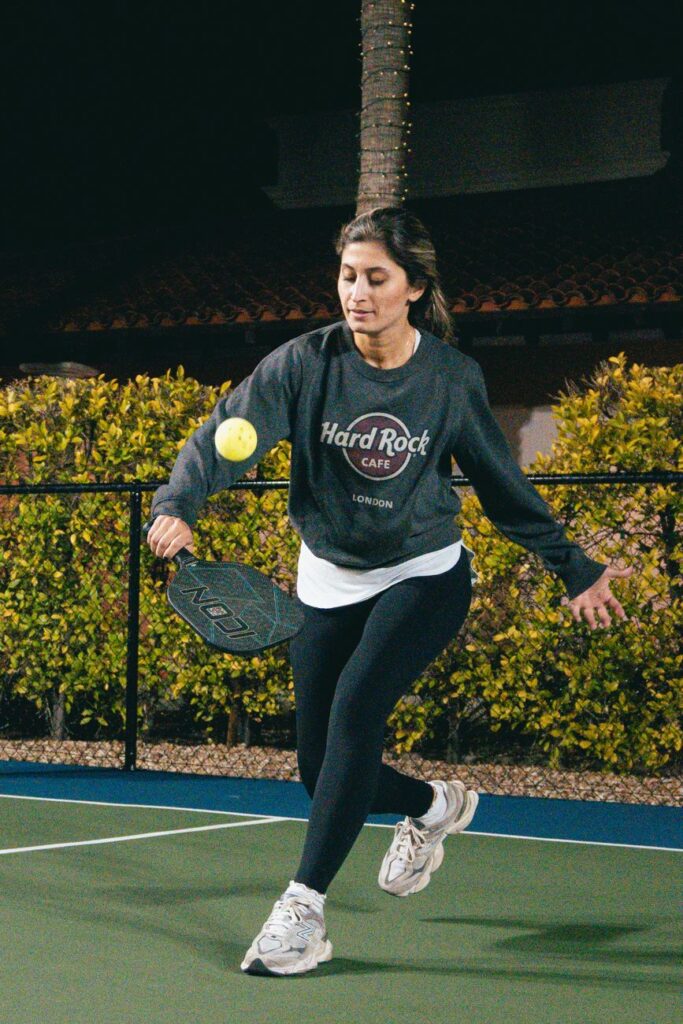
It is a defensive counter for a ball rising quickly into your body at the net. Instead of retreating — which is what your elbow wants to do — you drop your whole body down, get the paddle underneath the ball’s path with the face angled down, and redirect it. The name comes from the shape: crouched low with the paddle extended out and down, like a tail curling under.
The fix only makes sense once you understand the failure. The chicken wing is a protective reflex — something approaches your torso at speed and your body pulls back and lifts the arm across. In pickleball that costs you the point every time, for a mechanical reason:
- The elbow disconnects from your body. Once it flies out sideways you have lost any stable relationship between your shoulder, your hand and the paddle face.
- The face opens skyward. A raised, disconnected elbow rotates the paddle face upward. The ball goes where the face points.
- You are hitting up on a ball that is already travelling up. That is the definition of a pop-up, and at the kitchen line a pop-up is a conceded point.
The scorpion does not out-muscle the reflex. It replaces it with a different pre-programmed response, which is the only thing that actually works against a reflex. If you have read our guide to winning hands battles and speed-ups, this is the same principle applied to the one ball that guide does not fully solve: the one aimed at your midsection.
When do you use it instead of a block or a reset?
This is where most people get it wrong. The scorpion is not a general-purpose answer to pace — it is the answer to a very specific ball. Your existing tools still handle the rest:
| The ball you are facing | What to hit |
|---|---|
| Driven flat at you, roughly chest height, on a level path | Block volley — paddle out front, absorb |
| Attacked hard while you are stuck mid-court or off balance | Reset into the kitchen and rebuild |
| Struck from below net height and climbing into your chest or hip | Scorpion — drop under it, closed face |
| At your feet after a bounce, or dying short | Half-volley |
| Above net height and attackable | Put it away — no defensive shot needed |
The signal that separates row three from row one is your opponent’s body, not the ball. When a player has to reach down, physics does the rest of the work for you: a paddle contacting the ball below net height cannot send it on a flat path and still clear the net, so it has to go up. That arc is slower than a flat drive, and it buys you the fraction of a second you need to get low. A balanced opponent taking the ball at waist height is a different problem — block that one.
How do you hit it, step by step?
- 1. Read the reach. The instant you see a stretch or a lunge toward a low ball, commit. Do not wait to confirm with your eyes where the ball is going; by then it is on you.
- 2. Drop your hips, not your head. Bend at the knees and sit down into the shot. If you bend at the waist instead, your chest drops toward the ball and you have just made your own target bigger.
- 3. Get the paddle head below the ball’s path. Point the paddle tip down toward the floor. This is the part that feels wrong and is the whole shot. You want it in position before arrival, not swiped at on the way.
- 4. Close the face and tuck the elbow. The face angles slightly downward, the elbow stays in contact with your ribs. A wide elbow from a crouch is just a chicken wing at a lower altitude.
- 5. Absorb — do not swing. Let the ball arrive into a soft, stable paddle. Loosen the grip on contact. You are redirecting borrowed pace, and a full swing from a low base has no control whatsoever.
- 6. Get back up immediately. The shot is not finished when you make contact. Stay crouched and the next ball, which is often floated back over you, is unplayable.
Grip pressure is doing quiet work in step five. If you clamp down, the ball springs off the face and sails. If you have never deliberately worked on it, our guide to grip and pressure is the prerequisite for every soft shot in the game, this one included.
Does dropping that low risk a kitchen fault?
Yes, and this is the part the coaching clips skip. The scorpion is a volley — you are striking the ball out of the air — and you are almost always standing right at the non-volley-zone line when you hit it, while dropping your body weight forward and down. That is precisely the situation the kitchen rules are written about.
USA Pickleball’s own rules summary puts it plainly. It is a fault if, when volleying a ball, the player steps on the non-volley zone, including the line, or when the player’s momentum causes them or anything they are wearing or carrying to touch the non-volley zone. It is also a fault if, after volleying, a player is carried by momentum into the zone — even if the ball has already been declared dead.
Read that against what your body actually does in a deep scorpion. Three things bite people:
- A hand down for balance. Drop that low in a hurry and the free hand instinctively goes to the ground. If it lands past the line, that is a fault.
- Momentum on the recovery. You are dropping weight forward. Standing back up frequently carries a foot over the line, and the rule counts what happens after the shot, not just at contact.
- Anything you are carrying. The rule says anything. A hat, sunglasses off your head, a paddle touching down.
The fix is to drop down rather than forward — sit into your heels, not out over your toes. Worth knowing too: a player may legally be in the kitchen at any time other than when volleying, so if the ball has bounced first you can crouch wherever you like. Only the out-of-the-air version carries this risk. The zone is seven feet from the net on each side — see court dimensions.
What goes wrong the first ten times?
- Going down too late. The most common one by far — you react to the ball rather than to the reach, and arrive underneath it after it has passed your chest.
- Half-committing. A small knee bend with the paddle still at waist height is neither a block nor a scorpion, and produces the worst of both.
- Staying down. Admiring the shot from a squat. Get up.
- Using it on the wrong ball. Drop into a scorpion against a flat chest-high drive and you have voluntarily removed yourself from a ball you could have blocked standing up.
Is this shot realistic if your knees are not what they were?
Honest answer: the full version is a deep, fast, loaded squat, and plenty of the people I play with around north central Massachusetts are not doing that repeatedly on a gym floor in February. That is a reason to scale the shot, not skip it.
The compact version keeps the three elements that matter and drops the one that costs you. Paddle head below the ball, elbow tucked, hands soft. Bend the knees only as far as is comfortable and buy the rest of the height by leaning your upper body away from the ball rather than sinking further. You lose the very lowest balls and keep the whole benefit on the ones arriving between hip and chest, which is most of them.
If you are managing knees, hips or a cranky elbow, it is genuinely worth reading our notes on common pickleball injuries and, if this is your first season back, pickleball for seniors, both of which take the load question seriously rather than telling you to push through it.
How do you drill it this winter?
New England’s indoor season is the right time for this, because the shot needs a cooperative feeder and a warm floor rather than a windy Tuesday in March.
- The feed drill. Partner stands in the transition zone and drives balls up at your midsection from below net height. Do not aim anywhere at first — the only success condition is that the paddle head got below the ball and the elbow stayed in.
- Shadow reps, no ball. Drop into the shape from your ready position and stand back up, ten times. You are training the legs to move that weight quickly, which is the real bottleneck.
- Add the read. Once the shape is automatic, have the feeder mix in flat chest-high drives, so you are practising the decision from the table above rather than the shape.
- Then stop. Two sessions is usually enough. This is a low-frequency shot — it does not deserve a standing place in your routine the way the split-step does.
One last thing, and it is the real reason to bother. The value of this shot is not the points you win with it directly, which will be a handful a month. It is that opponents stop attacking your body once it stops working. That is the same compounding logic behind everything in our skills and drills library: the shot you can hit changes the shots you get offered.
The framing for this piece came from The Dink’s write-up of the scorpion, which built on a tutorial from tanner.pickleball. The kitchen-rule analysis and the drills here are ours. If the terminology in this piece is new, the glossary has the rest of it.
Written by Jason Regan, who runs Regan Family Pickleball out of Leominster, Massachusetts, teaches a community pickleball course locally, and plays open play across north central Massachusetts most weeks.
Related reading: hands battles & speed-ups · block, punch & roll volleys · resetting · the half-volley · find your paddle · all our skills guides