Quick answer: Here is how to cover a lob in pickleball. The instant the ball goes up over your partner, you turn and drop back diagonally behind it, call the ball out loud, and then either hold your original sides or announce a switch. The player who did not get lobbed almost always has the better read, because you are tracking the ball from the side instead of staring straight up at it.
The 30-second version
- A lob is a team problem. Most rec players treat it as the lobbed partner’s mess to clean up. That is the mistake that costs the point.
- You see it better than they do. From the side you read the arc a full beat earlier, which is why you should often be the one taking it.
- Drop back diagonally, not straight back. Backpedaling straight is how people fall. Turn your hips and run.
- Get behind the ball, not under it. Reaching kills placement. Set up so contact is out in front.
- Then make one decision and say it. Stay in your lanes, or switch. Silence is what actually loses the rally.
- Reset first, be a hero later. A soft drop back to the kitchen beats a desperate overhead nine times out of ten.
You know the sequence. Somebody floats a lob over your partner’s head, your partner scrambles backward, gets under it late, and pops up a sitter. The other team puts it away. Nobody says anything, everybody resets, and then it happens again three points later. I have watched this play out on every court from Leominster to the Cape, and the fix almost never lives with the person who got lobbed. It lives with you – the partner standing there watching.

Why does a lob do so much damage in rec doubles?
It is not usually because your partner has a bad overhead. It is because they read the ball late and arrive off balance.
- Straight overhead is the worst viewing angle in the sport. When a ball is directly above you, you lose almost all depth perception. You cannot tell if it is landing on the baseline or three feet short until it is far too late.
- Backpedaling is slow and unstable. Shuffling straight backward covers maybe half the ground of a proper turn-and-run, and it is the single most common way people go down hard on a pickleball court.
- Reaching wrecks the shot. Contact behind your head means no weight transfer, no target, and no disguise. You are giving the ball back with interest.
- The team collapses with them. While one player retreats, the other usually freezes at the kitchen – which leaves a wide open court and no coverage in the middle.
So the goal is not to make your partner better at hitting overheads on the run. The goal is to stop them from having to.
How to cover a lob in pickleball: the three-step read
Three steps, in this order, every time. They take longer to describe than to do.
Step 1 – Read it from the side and commit early. The moment you see the paddle face open up under the ball, you are already moving. Do not wait to see whether your partner can get it. By the time you know the answer, the point is over. Your side view is the whole advantage here – use it in the first half second.
Step 2 – Drop back diagonally, behind the flight path. Turn your hips toward the back corner the ball is heading for and run. Do not shuffle, do not backpedal. You are aiming for a spot roughly a step behind where you think the ball will land, on the diagonal – which means you are crossing behind your partner, not beside them.
Step 3 – Set up so contact is in front of you. This is the part almost everyone skips. Getting to the ball is not the same as getting behind it. If you arrive underneath it, you are hitting the same panicked reach your partner would have. Give yourself that extra step so you can take the ball out in front with your feet set.
Done properly, what looked like a defensive scramble turns into a controlled reset. That is the whole trick: a lob is only an emergency if you treat it like one.
Who should take the ball, you or your partner?
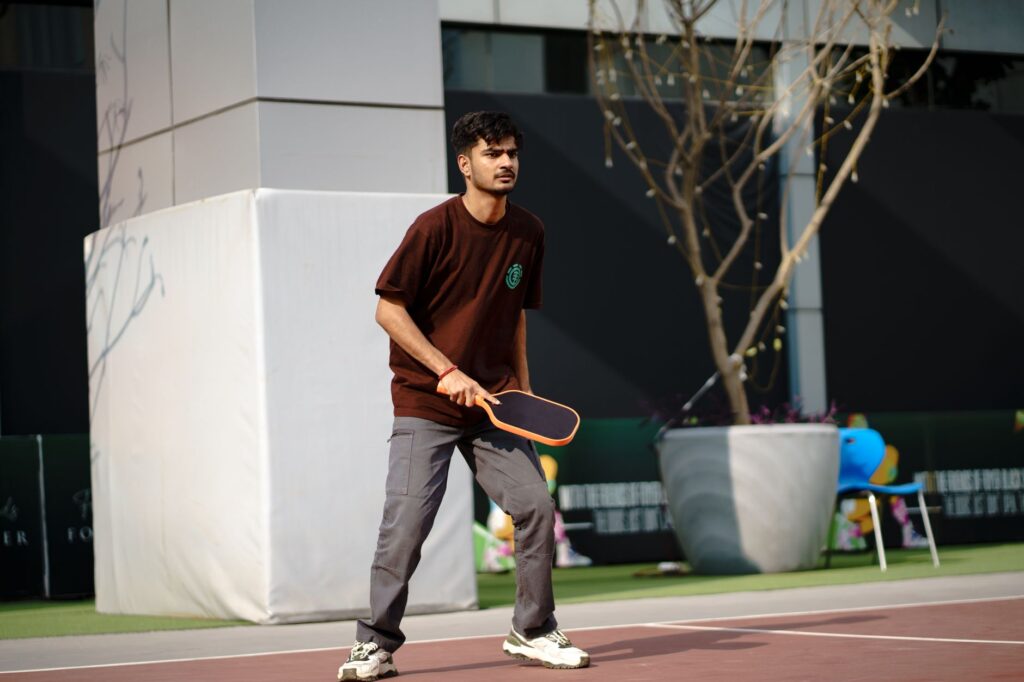
Default to you – the player who was not lobbed – whenever you can comfortably get behind the ball. Take it when:
- The ball is clearly travelling over your partner’s head rather than out to their side.
- You have a clean diagonal path and are not going to collide with them.
- Your partner has already turned and is chasing, which means they are behind the play and reaching.
Leave it to your partner when the lob is short enough that they can step back and take it comfortably in front, or when it is drifting to their forehand side and they have called it. And if it is going over their backhand shoulder, that is the strongest case of all for you to take it – the running backhand overhead is one of the hardest shots in the game and there is no reason to hit it on purpose.
Should you switch sides after covering the lob?
Once you have tracked the ball down and made contact, you and your partner are standing in the wrong places. You have two clean options, and either one works – as long as you pick one.
Option 1 – Hold your original lanes. You hit your drop, your partner holds their spot at the kitchen, and you recover forward into the space you started in. This is simplest when you have only drifted a step or two off your side and you can get back before the next ball arrives.
Option 2 – Switch. You have crossed behind your partner, so you finish on their side and they slide across to yours. This is usually the right call when you have run a long way, because trying to sprint back across the court diagonally is how you end up out of position twice. If your team already plays with stacking, this will feel familiar.
The wrong option is the third one nobody chooses on purpose: both players drifting toward the middle, hoping the other one has it, leaving both sidelines open. That happens entirely because of the next section.
What should you actually say out loud?
Two calls, and they need to be loud enough to be rude about it.
- Claim the ball early: “Mine!” Say it while you are still moving, not at contact. Your partner needs that information in time to clear out and get to the kitchen.
- Call the rotation at contact: “Switch!” or “Stay!” One word. Your partner cannot see you – you are behind them – so they are relying entirely on your voice.
Agree on your two words before the match, not during it. Partners who have never discussed this end up shouting three different things at once, which is worse than saying nothing. There is more on building that shorthand in our guide to pickleball partner communication.
Where should your shot go once you are behind the ball?
You are deep, off balance, and out of position. This is not the moment to win the point. It is the moment to survive it and get back to even.
- Go soft and go deep-ish. A high, slow ball that lands near their kitchen line buys you the two or three seconds you need to recover. Think of it as a third shot drop hit from further back.
- Aim crosscourt. The diagonal is the longest distance on the court and the net is lowest in the middle, so a crosscourt ball gives you the biggest margin.
- Avoid the aggressive drive. Driving from deep off a lob you just chased down is the single most common way this rally ends badly. You are hitting on the run into two players already at the net.
- Lob them back if you are truly stretched. If you got there late and cannot control a drop, a high defensive lob of your own is a perfectly respectable answer.
Does any of this change on New England courts?
More than you would think, and it is worth planning for.
- Winter indoor play changes the ceiling, literally. A lot of our indoor pickleball in New England happens in repurposed gyms, church halls and field houses with low ceilings, beams and light fixtures. Learn the house rule on ceiling contact before you play, and know that in a low room the lob mostly disappears as a weapon – which means the players who rely on it are suddenly beatable.
- Spring and fall wind is the real lob coach. On exposed outdoor courts, especially anywhere near the coast, a lob that looked long will hang and drop short, and a lob that looked short will keep sailing. When it is breezy, take one extra step back than your eyes tell you to.
- Evening sun is brutal on east-west courts. Plenty of town courts run the wrong way for a 6pm summer session. If you are the one facing the sun, tell your partner at the start of the game that you are taking fewer overheads – that is a strategy conversation, not an excuse.
If you are hunting for somewhere to work on this, our New England court directory lists indoor and outdoor options across all six states.
What drill fixes lob coverage fastest?
The Two-Call Drill. Ten minutes, three players, no scoring.
- Two players start at the kitchen line as partners. A third stands at the opposite baseline with a bucket of balls.
- The feeder lobs at random over one of the two – the pair does not know which until it is in the air.
- The non-lobbed partner must do all three things: call “Mine!” before they reach the ball, drop back diagonally, and call “Switch!” or “Stay!” at contact.
- The rally then plays out normally until someone wins the point.
- Scoring twist: if either call is missing, the pair loses the rep even if they win the rally. You are training the voice, not the shot.
Ten minutes of this will do more for your doubles than an hour of hitting overheads at a wall. Most teams find the calling is far harder than the running – which is exactly the point.
Frequently asked questions
Is it legal to switch sides with your partner mid-point?
Yes. In doubles, once the serve has been returned, you and your partner may stand anywhere on or off the court, on either side. Positioning only matters on the serve and return. You can find the full text in the official rulebook from USA Pickleball.
Should I ever let a lob bounce?
Often, yes. If the ball is clearly going to land in and you cannot get behind it in the air, letting it bounce buys you time and gives you a normal groundstroke instead of an awkward overhead. The one exception is a high, deep lob on a fast surface, where the bounce can carry it past you.
How do I know if the lob is going out?
Watch the arc, not the ball. A lob that peaks before it crosses the net is almost always landing in. A lob still climbing as it passes over your partner is the one to let go. When you are genuinely unsure, play it – a ball you let drop that lands in is a lost point, while a ball you play that was going out costs you nothing but a rally.
My partner never calls the ball. What do I do?
Take over the calling yourself and be explicit about it before the next game starts. Tell them plainly that you will call every lob that goes over their head, and all they have to do is clear toward the kitchen when they hear it. One-sided communication is far better than none.
Does covering lobs matter at the 3.0 level, or is it a 4.0 skill?
It matters most at 3.0 and 3.5, because that is exactly where the lob is used constantly and defended badly. By 4.5 opponents lob less, since good teams punish a bad one. Learning to cover lobs early is one of the cheapest rating points available – see our guide on moving from 3.5 to 4.0.
Source note: the three-step framing in this article was prompted by a breakdown published by The Dink Pickleball on 21 August 2026, which drew on video coaching from Richard Pickleball. The drill, the calling system, the shot-selection guidance and the New England specifics above are our own.
Written by Jason Regan, who runs Regan Family Pickleball out of Leominster, Massachusetts, and has spent more open-play sessions than he can count watching perfectly good points die because nobody said a word. Want to work on this in person? See coaching.
Related reading: pickleball doubles strategy · court positioning · how to hit an overhead