Quick answer: Who takes the middle ball in pickleball comes down to one default and a short list of exceptions. The default is that the forehand takes the middle — whichever partner can reach the ball with their forehand plays it. The exceptions matter almost as much: the player already moving toward the ball takes it, the player the ball is travelling toward takes it, and on any ball above net height the player who can attack it takes it. And none of this is in the rulebook. It is convention, which is exactly why it breaks down with a new partner.
The 30-second version
- Default: forehand takes the middle. It is the longer reach and the stronger wing for most players.
- Momentum beats the default. Whoever is already moving toward the ball has it, forehand or not.
- Height beats both. If the ball is above the net, the partner who can hit down on it takes it — no debate.
- Call it before the bounce, not after. One word, early. Late calls cause the collision.
- The non-hitter has the loudest job. Calling your partner off is easier than claiming a ball mid-swing.
- Two lefties or a righty-lefty pair invert everything — the two-forehand middle is a weapon, the two-backhand middle is a hole.
- Nothing in the rulebook assigns the middle. It is a team agreement, so make it out loud in the ten seconds before the first serve.
The middle ball is the most winnable free point in recreational pickleball, and both teams know it. Aim between two opponents and one of two good things happens: nobody plays it, or both of them do and one gets in the other’s way. I watch it happen a dozen times an afternoon at open play, almost always between two perfectly competent players who have simply never had the conversation. Here is the conversation, in the order it actually matters.
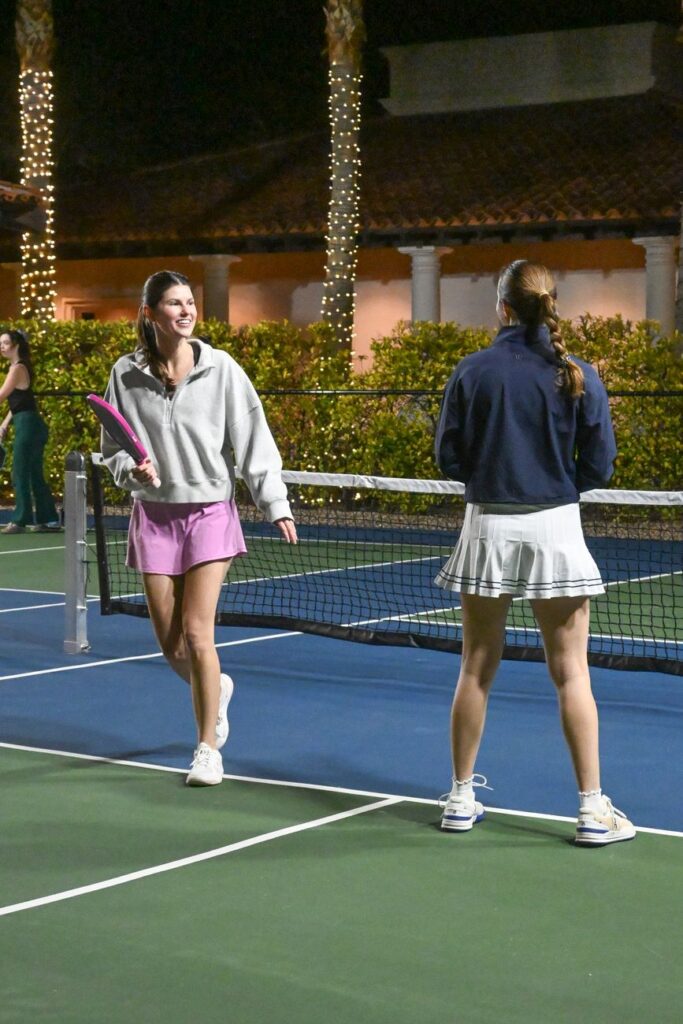
Who takes the middle ball in pickleball by default?
The forehand takes the middle. If you remember nothing else, remember that.
Two reasons, and both are physical rather than a matter of taste:
- Reach. Your forehand side extends further from your body than your backhand does. On a ball splitting the two of you, the forehand player simply gets there with a comfortable arm and the backhand player gets there cramped.
- Strength. For the large majority of players, the forehand is the more reliable wing — more pace available, more spin available, fewer shanks under pressure. Given the choice between the two paddles that can reach the ball, you want the better one on it.
For a standard right-handed pair, that means the player on the left side of the court owns the middle, because their forehand points into it. That is also why the left side is traditionally the more experienced player’s side in doubles — not because it is harder, but because they end up hitting a disproportionate share of the balls.
This is a default, not a law. Everything below overrides it.
Why does the middle ball cause so many errors?
Because two players making a reasonable decision at the same time produces an unreasonable result. There are really only three failure modes, and it is worth knowing which one you keep having:
- Both of you watch it. Each assumes the other is on it, the ball lands between you, and everybody looks at each other. This is the most common and the most annoying.
- Both of you swing. Paddles clash or the backhand player gets a piece of it first and pops it up from a cramped position. You lose the point and occasionally a paddle.
- The wrong one takes it. The backhand player claims a ball their partner’s forehand could have crushed. You survive the point but you gave up the advantage.
Notice that all three are communication failures, not technique failures. You do not fix them with a better drive. You fix them with a default plus a word.
When should the backhand take the middle instead?
Five situations override the forehand default. In roughly the order they should win:
- 1. Momentum. Whoever is already moving toward the ball takes it. A player travelling into a shot beats a player who has to reverse direction, even if that means a backhand plays it. Do not stop a moving partner to enforce a rule of thumb.
- 2. Height. If the ball is above net height, the partner who can hit down on it takes it. An attackable ball is worth far more than a tidy convention — see our guide to finishing points.
- 3. Direction of travel. A ball angling across the court belongs to the player it is moving toward, not the player it started nearest. Chasing a ball that is running away from you is how you end up reaching across your partner.
- 4. Recovery. If your partner is out of position — pulled wide, still recovering from an ATP, coming back from the baseline — the middle is yours regardless of which wing you use. Cover the court that is actually empty.
- 5. Speed-ups at the kitchen. In a fast exchange there is no time to apply any of this. The rule collapses to: whoever can get a paddle on it, does. Read our guide to hands battles for how to hold your position in those.
Here is the whole decision in one place:
| Situation | Who takes it |
|---|---|
| Neutral ball, both of you set | The forehand |
| One of you already moving toward it | The player in motion |
| Ball above net height | Whoever can hit down on it |
| Ball angling across court | The player it is moving toward |
| Partner out of position | The player who is set |
| Fast hands exchange | Whoever reaches it — no thinking |
| Lob over the middle | The player who can turn and run, calling loudly |
How do you call the middle ball without talking over each other?
Most pairs communicate too much and too late. The fix is fewer words, earlier.
- One syllable, not a sentence. Mine, yours, me, go. By the time you say something longer the ball has bounced.
- Call before the bounce, not at contact. The single biggest upgrade available. A call at contact is a report, not information — your partner has already committed.
- The person not hitting has the easier job. Calling your partner onto a ball is far easier than claiming one mid-swing, because you have a clear view and no shot to play. If you are the off-ball player, you are the one who should be talking.
- Do not call the ball out and call for the ball in the same breath. Pick one. Mixing them is how a partner freezes.
- Silence means the default. Agree in advance that if nobody says anything, the forehand takes it. Then a quiet point is still a decided point.
There is a lot more on signals, sides and pre-point agreements in our guide to partner communication.
Where should you stand so the middle is not a hole?
You can solve most middle-ball problems before the ball is ever hit, by fixing the gap between you.
- Move as a unit. When your partner shifts left, you shift left. Two players joined by an invisible eight-foot rope. Most middle holes are created when one partner chases wide and the other stays home.
- Guard the middle, concede the line. This is the percentage play and it feels wrong at first. The down-the-line shot is lower percentage for your opponent and has less court to land in; the middle ball is the easy one. Give away the harder shot. We break the line side down in closing the down-the-line gap.
- Watch the gap, not the ball, between points. If you can see daylight between you and your partner from the kitchen line, you are too wide.
Our full guide to court positioning covers how to move up and hold the line as a pair, and poaching covers the deliberate version of crossing into your partner’s space.
What if you play with a lefty?
Everything inverts, and it is worth planning for rather than discovering mid-game.
- Righty on the left, lefty on the right: you have two forehands in the middle. This is the strong configuration — the middle becomes a weapon and you can be genuinely aggressive with it. The risk shifts from missed balls to collisions, so the calling discipline matters more, not less.
- Righty on the right, lefty on the left: you have two backhands in the middle. This is the vulnerable one. Opponents who notice will target the seam relentlessly. Agree explicitly on who takes it, tighten the gap, and consider stacking to keep the forehands inside.
We have a full playbook for this in playing with a lefty partner.
What does the rulebook say about the middle?
Nothing — and that is genuinely useful to know. USA Pickleball’s official rules govern where you may not be (the non-volley zone while volleying), what counts as a fault, and how serving and receiving positions work. During a rally, partners may position themselves anywhere on their own side of the net, and either partner may play any ball.
So there is no rule to appeal to. The middle is a team agreement, and different groups genuinely play it differently. That is precisely why you should say it out loud with someone new instead of assuming they share your default.
How do you drill the middle ball?
Drill 1 — The seam feed (10 minutes). One feeder, two players at the kitchen line. The feeder deliberately targets the seam between them, mixing heights: below net, at net height, above net. Every ball must be called before the bounce, out loud, by somebody. Score it on calls, not winners — a point where the right player took it silently still counts as a miss.
Drill 2 — Two on one middle (10 minutes). Two players cover the whole court against one opponent who is only allowed to hit into the middle third. Forces the pair to shuffle as a unit and exposes the gap immediately. Rotate the single player every three minutes.
Drill 3 — Silent set, spoken set. Play a game to 11 where no one may speak, then a game where every ball down the middle must be called. The score difference between the two games is the honest measure of how much your communication is worth. For most rec pairs it is three or four points.
If you are on your own, the wall drills that build a fast forehand-to-backhand switch will help the reaching part of the problem, though not the talking part.
The New England wrinkle: you rarely pick your partner
Everything above assumes a regular partner you can build habits with. Around here, most people do not have one. Town open play at the courts in Leominster, the winter sessions that pack out gyms across the region from November through March, the rotating paddle-stack systems at nearly every public court in New England — you get four new partners an hour and no time to develop anything.
So make it a ten-second script you run before every first serve, with everyone, every time:
- Forehand takes the middle, sound good?
- Are you a lefty? (Ask. Do not find out on the third point.)
- Call it early, I would rather we both hear it.
It takes less time than tying a shoe, it works with a complete stranger, and it eliminates the single most common way rec teams hand away points. I teach exactly this in the community classes I run locally, and it is consistently the change that produces the biggest immediate jump — ahead of any shot.
Frequently asked questions
Who takes the middle ball in pickleball doubles?
The default is that the forehand takes the middle, which for a right-handed pair means the player on the left side of the court. That default is overridden by momentum, ball height, direction of travel and court position, in that order.
Does the forehand always take the middle in pickleball?
No. It is a default, not a rule. If one player is already moving toward the ball, or the ball is above net height and one player can attack it, or a partner is out of position, those situations win. The forehand default only settles genuinely neutral balls.
What do you say when you take the middle ball?
One syllable, before the bounce. Mine, me, yours or go. Longer calls arrive too late to be useful, and the partner who is not hitting is usually better placed to make the call than the one who is.
Is there a rule about who hits the ball in pickleball doubles?
No. Aside from the serve and return, which must be played by specific players, either partner may play any ball during a rally, and partners may stand anywhere on their own side of the net. Who takes the middle is team convention rather than a rule.
Should you guard the middle or the sideline in pickleball?
Guard the middle. The middle ball is the higher-percentage target for your opponents and the easier shot for them to execute, while the down-the-line shot has less court to land in. Conceding the line and protecting the seam is the better trade over a full game.
Written by Jason Regan, who runs Regan Family Pickleball out of Leominster, Massachusetts, teaches a community pickleball and real estate course locally, and plays open play across north central Massachusetts most weeks.
Related reading: court positioning · partner communication · the doubles playbook · poaching · all our skills guides